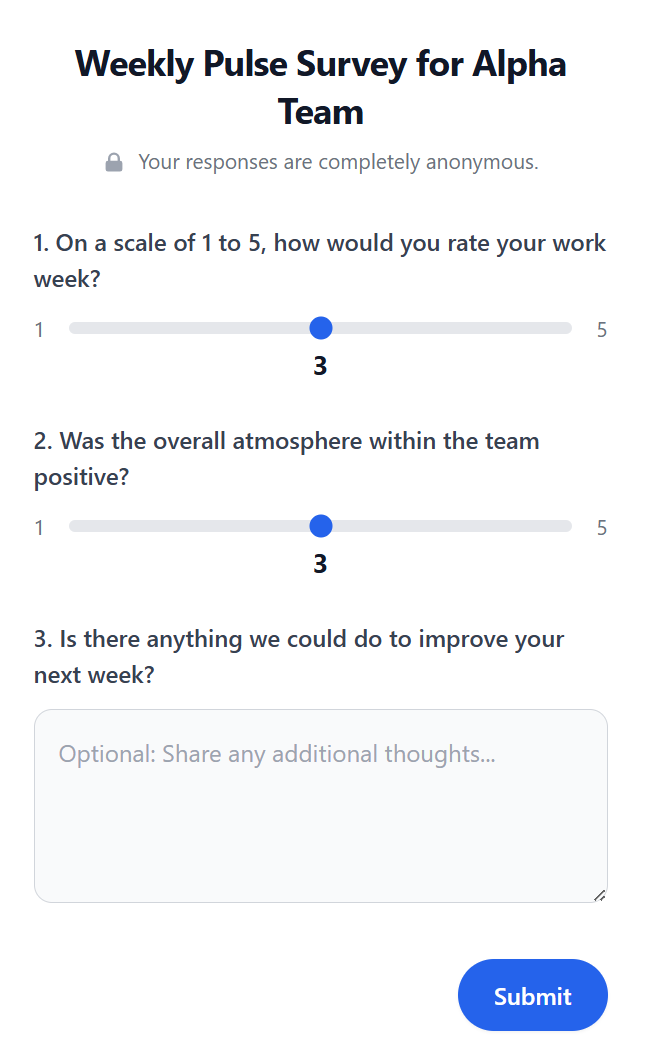
If you've received an invitation to a Sentialytics survey, or if you're thinking of introducing it to your team, it's normal for the first question to be: "Are my answers really anonymous?".
The short answer is: yes, 100%.
The long answer is that we don't ask you to trust a promise, but a system specifically designed to be technically anonymous. In this article, we'll explain exactly how it works, without the jargon.
"Anonymity by Design": Anonymity as a Feature, Not a Policy
For us, privacy isn't a policy written in fine print at the bottom of a page. It's the foundation upon which our entire system architecture is built. We call it "Anonymity by Design," and it rests on two unbreakable technical pillars.
1. The Structural Wall: Separated and Decoupled Data
Imagine two locked safes in different rooms.
- In the first safe (our Users database), there's the list of your team's email addresses. The system uses this list for one purpose only: to send each person a personal, single-use link to the survey.
- In the second safe (our Responses database), the survey answers (scores from 1 to 5 and comments) are stored.
The key point is this: when you respond to the survey via your link, your answer is "thrown" over a wall and lands in the second safe, but it forever loses any connection to who sent it. The system only records that your single-use link has been used (so as not to send it to you again), but your answer arrives in the responses safe in a completely anonymous form, with no name, email, or code that can be traced back to you.
This approach is based on two recognized security and privacy principles: data minimization and separation of duties. In practice, the table that manages invitations (SurveyInvitations) only knows if you have responded, but not what you responded (minimization). The table that contains the responses (SurveyResponses) only knows what was responded, but not by whom (separation). Because the two tables are technically disconnected, no single part of the system holds all the information, thus guaranteeing anonymity.
2. Group Protection: The Minimum Response Threshold
"Okay," you might think, "but what if we're a small team? Couldn't someone 'deduce' who said what?"
We've thought of that too. To prevent any kind of deductive analysis, aggregated results and insights are only shown to the manager when a minimum threshold of 5 responses for a given team is reached.
If only 4 people respond in a week, no one will see the results for that week. That data will only contribute in an aggregated form to the general long-term trends (which are calculated over 28-day windows), making it impossible to isolate a single week and further protecting the identity of those who responded.
What This Means in Practice
- For team members: It means you can express yourself with total honesty and safety. Your voice is important, and our system is built to protect it so you can help improve your work environment without any hesitation.
- For managers: It means the data you receive is more genuine and therefore infinitely more useful. You are creating a feedback channel that your team can trust, and that is the foundation for real, lasting improvement.
Trust is our first ingredient. Without it, all the data collected would be useless.
Ready to build a dialogue based on trust?
Trust is built on transparency and consistent, safe listening. Sentialytics gives you the anonymous channel to start this dialogue, understand your team's real needs, and become the leader people can trust.
Start Now